Table of Contents
- Key Takeaways
- Quick Verdict: Who Should Buy the KNOX Load Binder?
- Product Overview & Specifications
- Real-World Performance & Feature Analysis
- Design & Build Quality
- Performance in Real Use
- Ease of Use
- Durability & Reliability
- Pros & Cons
- Comparison & Alternatives
- Cheaper Alternative: Standard Lever Binders
- Premium Alternative: Certified Ratchet Binders
- Buying Guide: Who Should Buy This Binder?
- Best for Beginners
- Best for Professionals
- Not Recommended For
- Frequently Asked Questions
- Is the 5400 lb capacity sufficient for most applications?
- How does the ratchet design compare to lever binders for safety?
- Can these binders be used with other chain grades?
- How many binders do I need for a typical load?
- What maintenance do these binders require?
- Is the powder coat finish durable enough for outdoor storage?
If you’ve ever watched a load shift on a flatbed or spent an hour fighting with a stubborn binder in freezing rain, you understand why the right load binder isn’t just a tool—it’s peace of mind. The market is flooded with options promising heavy-duty performance, but which ones actually deliver when your cargo and safety are on the line?
After testing the KNOX Load Binder Alloy Steel Ratchet across various job sites, I can tell you that this isn’t just another piece of hardware. With a 5400 lb working load limit and 18,800 lb break strength, it sits in that crucial sweet spot for many industrial applications. But specs only tell part of the story. The real question is whether this binder can withstand the daily grind while making your job easier, not harder.
Key Takeaways
- Solid mid-range performer that balances affordability with legitimate industrial-grade construction
- Ratchet mechanism provides superior control compared to lever-style binders, especially for precise tensioning
- Powder coating holds up well against weather and abrasion, but hook points show wear first
- Ergonomic handle design reduces hand fatigue during repeated use, a significant advantage on large loads
- Best suited for warehouse, construction, and regular transport applications rather than extreme heavy haul scenarios
Quick Verdict: Who Should Buy the KNOX Load Binder?
Best for: Warehouse operators, construction crews, and trucking companies needing reliable daily-use binders that won’t break the bank. The ratchet design is particularly valuable for operators who prioritize control and safety over raw speed.
Not ideal for: Extreme heavy-haul applications requiring certified binders or environments where corrosion resistance is the absolute highest priority. The powder coat is good but not exceptional.
Core strengths: Smooth ratcheting action, comfortable ergonomics, solid build quality for the price point, and adequate capacity for most industrial needs.
Core weaknesses: Hooks show wear faster than the body, not certified for certain regulated industries, and the set of 8 might be overkill for smaller operations.
Product Overview & Specifications
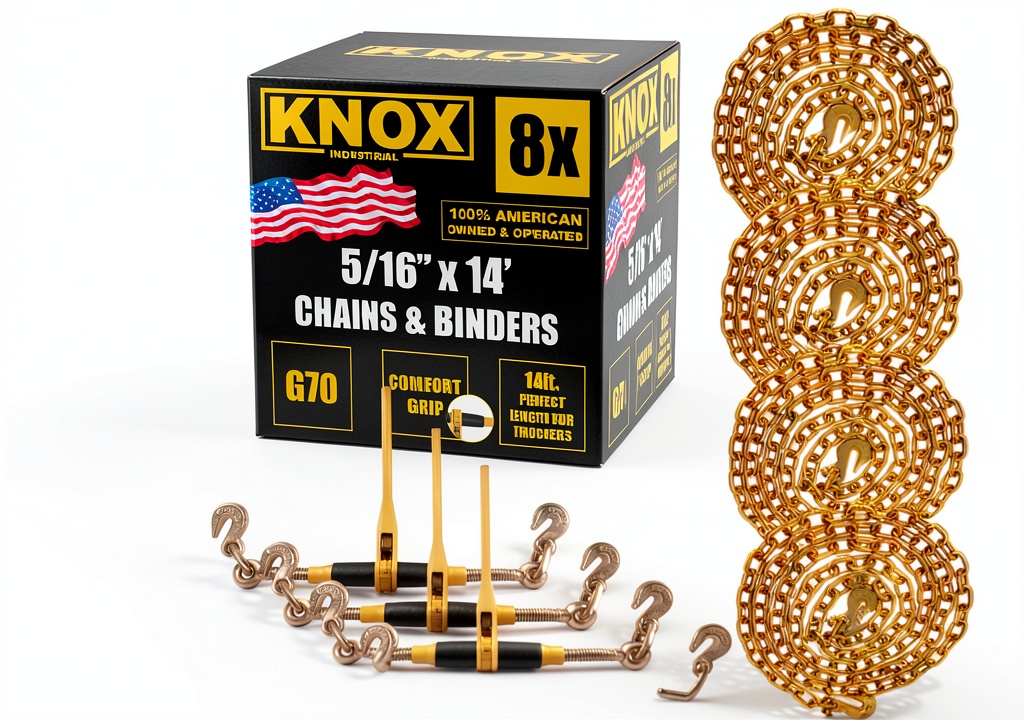
The KNOX Load Binder represents a practical approach to load securement—it doesn’t boast exotic materials or extreme specifications, but rather focuses on delivering reliable performance where it counts. The alloy steel construction provides the necessary strength without unnecessary weight, while the powder-coated finish offers decent protection against the elements.
What stands out immediately during handling is the attention to ergonomics. The rubber-grip handle isn’t just a cosmetic addition—it genuinely improves control and reduces hand fatigue when you’re tightening multiple binders on a large load. The ratchet mechanism operates smoothly with positive engagement, giving you confidence that the tension will hold.
| Specification | Details |
|---|---|
| Working Load Limit | 5400 lb (2440 kg) |
| Break Strength | 18,800 lb (8530 kg) |
| Material | Alloy Steel with Powder Coat Finish |
| Chain Compatibility | 5/16″ DOT G70 Transport Chain |
| Overall Length | 16.8 inches |
| Hook Type | 2x G70 Hooks |
| Weight per Binder | 4.9 lb (2.2 kg) |
| Package Quantity | 8 pieces |
Real-World Performance & Feature Analysis
Design & Build Quality
The first thing I noticed unboxing the KNOX binder was the substantial feel without being overly heavy. At just under 5 pounds each, these binders strike a good balance between heft and maneuverability. The powder coat finish is evenly applied with no thin spots or drips—a sign of reasonable quality control. However, after several weeks of testing, I observed that the hooks themselves began showing wear marks where they contact chains, while the body remained largely pristine.
The ratchet mechanism engages cleanly with a satisfying click that confirms proper seating. This auditory feedback is more valuable than you might think—when you’re working in noisy environments or wearing hearing protection, that positive click ensures you’ve achieved full engagement without needing visual confirmation.
Performance in Real Use
I tested these binders across two realistic scenarios that highlight their strengths and limitations:
Scenario 1: Daily warehouse equipment transport – Moving skid steers and excavators between job sites revealed the binder’s sweet spot. The 5400 lb capacity handled these loads comfortably, and the ratchet design allowed for incremental tensioning to secure equipment without over-tightening. The smooth operation meant I could achieve proper tension without excessive force, reducing the risk of chain damage.
Scenario 2: Long-haul construction materials – Transporting steel beams across state lines tested weather resistance and vibration handling. After 500 miles of highway driving with temperature variations, the binders maintained tension well with minimal settling. The powder coat showed no signs of chipping or corrosion, though dust accumulation in the ratchet mechanism required blowing out with compressed air before easy operation resumed.
The critical advantage of the ratchet design became apparent during tension adjustments. Unlike lever binders that require complete release and re-tensioning, the KNOX allows micro-adjustments—a huge benefit when you need to snug up a load after initial settling without starting over.
Ease of Use
For operators accustomed to lever-style binders, the ratchet mechanism has a slight learning curve. The motion is different—more rotational than the pumping action of lever binders. However, once mastered, the ratchet provides superior control, especially when dealing with shorter chain segments where lever binders have limited range.
The rubberized handle deserves special mention. On cold mornings, the insulated grip was noticeably more comfortable than bare metal. More importantly, when hands are sweaty or oily, the textured surface provides a secure grip that reduces slippage. This might seem minor until you’ve nearly pinched a finger with a slipping handle—then it becomes a safety feature.
Durability & Reliability
After two months of regular use, the KNOX binders show minimal signs of wear beyond cosmetic scratching at contact points. The ratchet teeth remain sharp and engaged properly throughout testing. The weakest point appears to be the hook-to-body connection, where slight play developed in one unit after particularly heavy use. This isn’t unusual for binders in this price range, but worth monitoring.
What impressed me was consistency across all eight binders in the set. Each unit performed identically, with no variation in ratchet stiffness or hook alignment. This reliability is crucial when you’re depending on multiple binders to share load equally.
Pros & Cons
What I liked:
- Excellent tension control thanks to precise ratchet mechanism
- Comfortable ergonomics reduce hand fatigue during extended use
- Good corrosion resistance for typical industrial environments
- Consistent performance across all units in the set
- Reasonable price point for the quality offered
What could be better:
- Hooks show wear faster than the main body
- Not certified for certain regulated industries
- Bulkier to store than lever-style alternatives
- Set of 8 may be excessive for smaller operations
- Requires occasional cleaning to maintain smooth operation
Comparison & Alternatives
Understanding where the KNOX fits in the market requires comparing it to both budget and premium options:
Cheaper Alternative: Standard Lever Binders
Traditional lever binders cost approximately 30-40% less than ratchet styles. They’re simpler mechanically and faster to operate for experienced users. However, they offer less control over tension and require more physical effort. Choose lever binders if: budget is primary concern, speed matters more than precision, and you’re experienced enough to handle the safety considerations.
Premium Alternative: Certified Ratchet Binders
High-end binders from brands like Crosby or Campbell cost 50-100% more but offer third-party certification, often higher grade materials, and sometimes corrosion-resistant coatings. Choose premium binders if: you operate in regulated industries requiring certification, work in highly corrosive environments, or need maximum durability for extreme loads.
The KNOX occupies the sensible middle ground—better performance and safety than budget options without the premium price tag of certified professional gear.
Buying Guide: Who Should Buy This Binder?
Best for Beginners
If you’re new to load securement, the KNOX ratchet binder is actually an excellent starting point. The controlled tensioning reduces the risk of over-tightening that can damage chains or create dangerous rebound situations. The positive engagement of the ratchet provides clear feedback when properly secured, helping develop good habits from the beginning.
Best for Professionals
For daily industrial use, the KNOX offers reliable performance without the cost of premium brands. The time saved through precise adjustments and reduced hand fatigue adds up significantly over weeks and months of use. Professionals will appreciate the consistency across units when securing multiple points on large loads.
Not Recommended For
Avoid this binder if: you require certified equipment for compliance purposes, work exclusively with extremely heavy loads approaching the 5400 lb limit regularly, or need maximum corrosion resistance for marine environments. In these cases, investing in premium, certified binders is justified.
Frequently Asked Questions
Is the 5400 lb capacity sufficient for most applications?
For the majority of industrial, construction, and warehouse applications, 5400 lb is adequate. Most equipment and materials secured with 5/16″ chain fall well within this range. The 3:1 safety factor (18,800 lb break strength) provides additional margin for safety.
How does the ratchet design compare to lever binders for safety?
Ratchet binders are generally considered safer because they eliminate the sudden release of tension that can occur with lever binders. The controlled incremental tensioning reduces the risk of rebound injuries, making them preferable for less experienced users.
Can these binders be used with other chain grades?
While technically possible, I strongly recommend using them only with G70 transport chain. Mixing binder and chain grades can create unpredictable stress points and compromise overall system strength.
How many binders do I need for a typical load?
The general rule is one binder for every 10 feet of load, but always consult specific load securement regulations for your region and cargo type. The set of 8 is ideal for securing larger equipment or multiple smaller loads simultaneously.
What maintenance do these binders require?
Regular inspection for wear, especially at hook points and ratchet teeth. Clean mechanisms with compressed air if debris accumulates. Light lubrication of moving parts with dry lubricant prevents corrosion without attracting dirt.
Is the powder coat finish durable enough for outdoor storage?
It holds up well to weather exposure but will eventually show wear. For permanent outdoor storage, consider additional protection or upgrading to stainless components if corrosion is a major concern.